
Services

Occupational, speech and ABA therapy for children in Greater Noida West.

This page explains what each service focuses on, which concerns it may help with, and why some children may benefit from one service while others need a shared plan across more than one area.

Medically reviewed by Dr. Prashant Kumar, M.O.T.
Occupational, speech and ABA therapy session at Shaping Minds in Greater Noida West

Definitions

Families comparing therapy options usually need a direct explanation first.

Occupational therapy helps with sensory regulation, motor planning, fine motor skills and daily independence. Speech therapy helps with understanding, expression, interaction and speech clarity. ABA-based support helps with engagement, transitions, routines and behaviour learning. Together, these services support children whose needs overlap across home, school and community life.

Families visiting from Greater Noida West, Noida, Ghaziabad, Crossings Republik and Delhi often begin with the concern they notice most right now, then use assessment and observation to decide the best service mix.

Planning principle

Good therapy planning starts with function: what is making the day harder, and what change would matter most?

The clinic focuses on practical outcomes like clearer communication, better regulation, stronger routines, improved participation and more confidence in daily tasks.

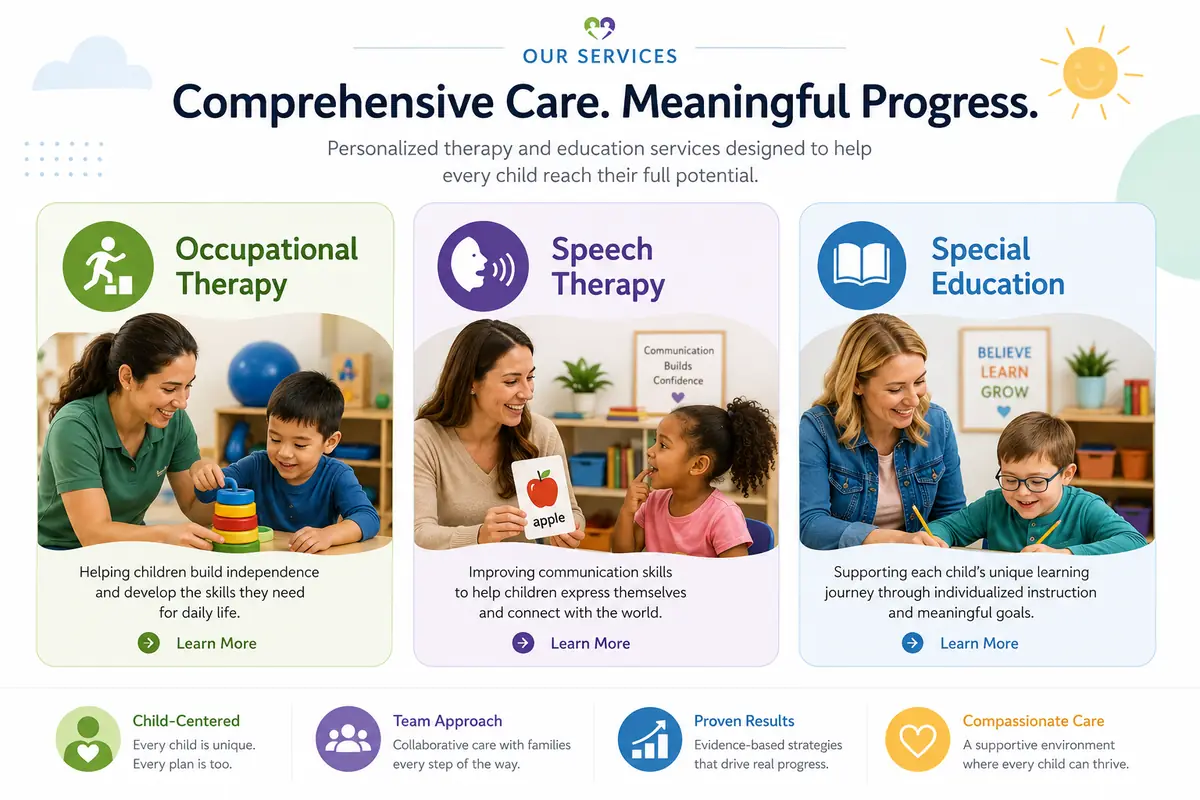
Occupational Therapy

Occupational therapy may support sensory processing, body awareness, attention, motor planning, hand use and daily independence.

  • Sensory regulation and participation
  • Fine motor control and hand skills
  • Self-care, routines and independence

Read the occupational therapy page

Speech Therapy

Speech therapy may focus on understanding, expression, interaction, speech clarity, social communication and confidence.

  • Language development and understanding
  • Speech clarity and expression
  • Functional communication in routines

Read the speech therapy page

ABA-Based Support

ABA-based support may help with engagement, routines, transitions, learning patterns, behaviour goals and participation.

  • Task engagement and structured learning
  • Routine consistency and transitions
  • Behaviour support linked to daily participation

Read the ABA-based support page

Special Education

Special education guidance supports school readiness, concept-building, attention, classroom participation and learning confidence.

  • Academic readiness and concept development
  • Attention and task completion
  • School-support strategies for carryover

Psychological Assessments

Assessments can clarify developmental patterns, behaviour concerns, learning profile questions and the best next steps for planning.

  • Structured observation and discussion
  • Developmental understanding
  • Recommendations for follow-up support

Who may benefit

Children often come with mixed needs, so services may overlap in practical ways.

A child may need better attention and sensory regulation before classroom learning improves, or stronger communication before behaviour becomes easier to manage. That is why support is considered in context, not in isolation.

Autism support Developmental delay Speech delay Sensory challenges Motor skill development Learning support Behaviour support Attention and participation
Speech therapist using a picture board with a child during a guided communication session
Occupational therapist supporting a child with block play and fine motor development

How planning can work

Good planning is less about labels and more about what helps the child function better every day.

Start with the main concern

The first step is identifying what is most affecting communication, regulation, independence, learning or participation right now.

Match the right service mix

Some children may need one primary route. Others benefit when goals are shared across more than one support area.

Review as the child grows

As progress appears, goals can shift from basic participation toward stronger independence, learning and confidence.

Common questions

Questions parents ask before choosing a service.

How do parents know whether occupational therapy or speech therapy should come first?

Parents can begin with the concern they notice most, and the clinic can use observation to suggest whether regulation, communication, assessment or behaviour support should be prioritised first.

When might ABA-based support be useful?

ABA-based support may be useful when a child needs structured work on routines, transitions, engagement, consistency, behaviour goals and participation.

Do children sometimes need more than one service?

Yes. Many children benefit from a combined plan when communication, sensory, learning and behaviour needs overlap.

Need help choosing the right starting point?

Call the clinic and begin with the concern you are seeing today.